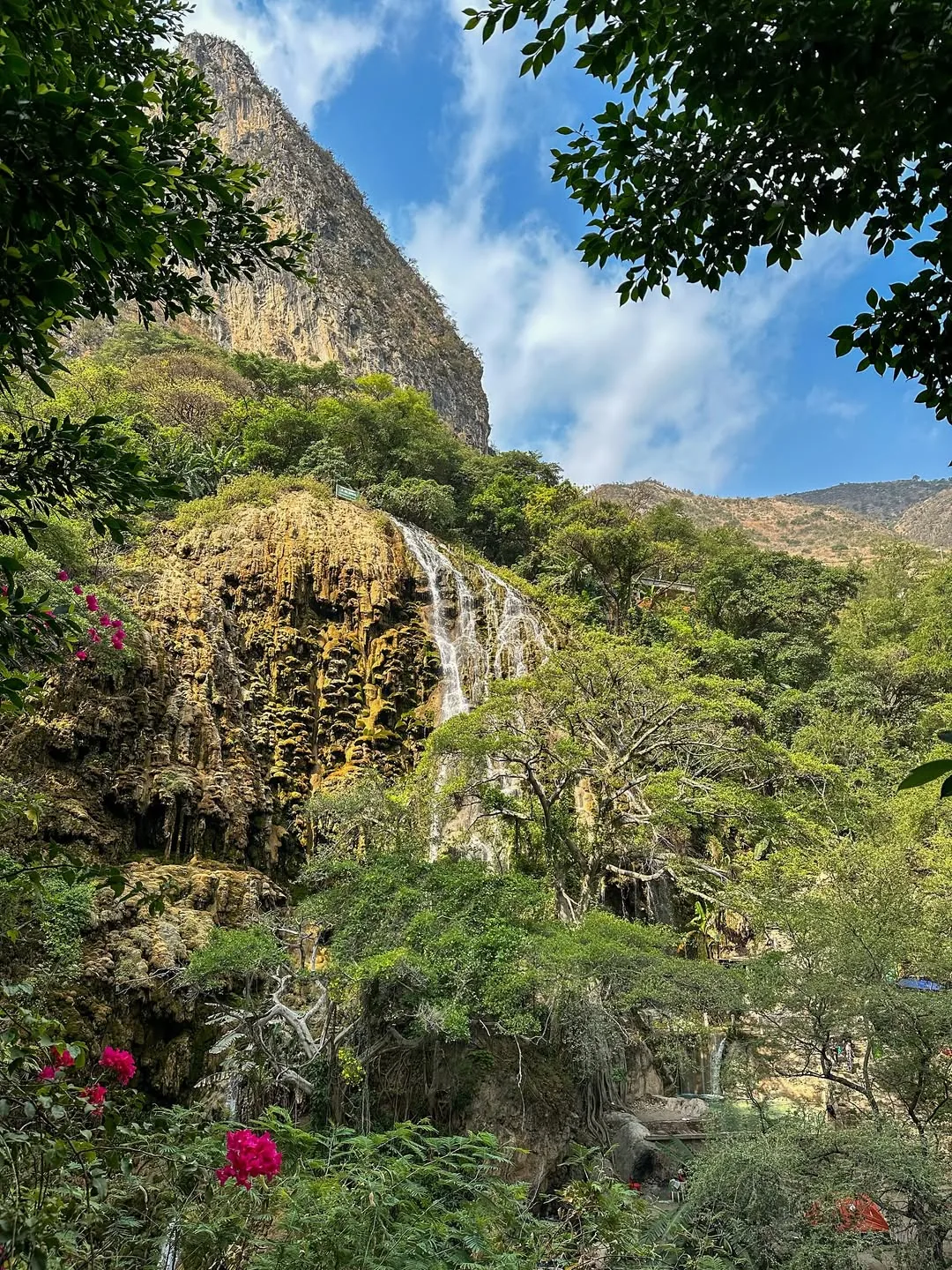
The Grutas de Tolantongo are a system of natural thermal caverns located inside a 300-meter-deep canyon in the Sierra Madre Oriental, municipality of Cardonal, Hidalgo, Mexico. Formed over millions of years by the action of water on limestone, these grottoes harbor thermal springs that flow at 36°C to 38°C (97°F-100°F) year-round, creating a geological ecosystem unique in North America.
How Were the Grutas de Tolantongo Formed?
The Grutas de Tolantongo formed over approximately 30 million years through a process of karstic dissolution, where acidic groundwater gradually dissolved the Cretaceous limestone that makes up the Sierra Madre Oriental. This geological process continues to this day.
The formation began during the Oligocene period, when rainwater filtered through fractures in the earth’s crust. As it descended to depths exceeding 1,500 meters, the water was heated by the Earth’s natural geothermal gradient, which increases approximately 3°C for every 100 meters of depth. That hot water, charged with dissolved carbon dioxide, became a weak carbonic acid capable of dissolving the limestone.
Over millennia, the water carved increasingly wider conduits within the rock. The main caverns widened to heights of 8 to 12 meters in their broadest sections. Simultaneously, the Tolantongo River carved the canyon from the surface, exposing the grotto entrances in the cliff walls.
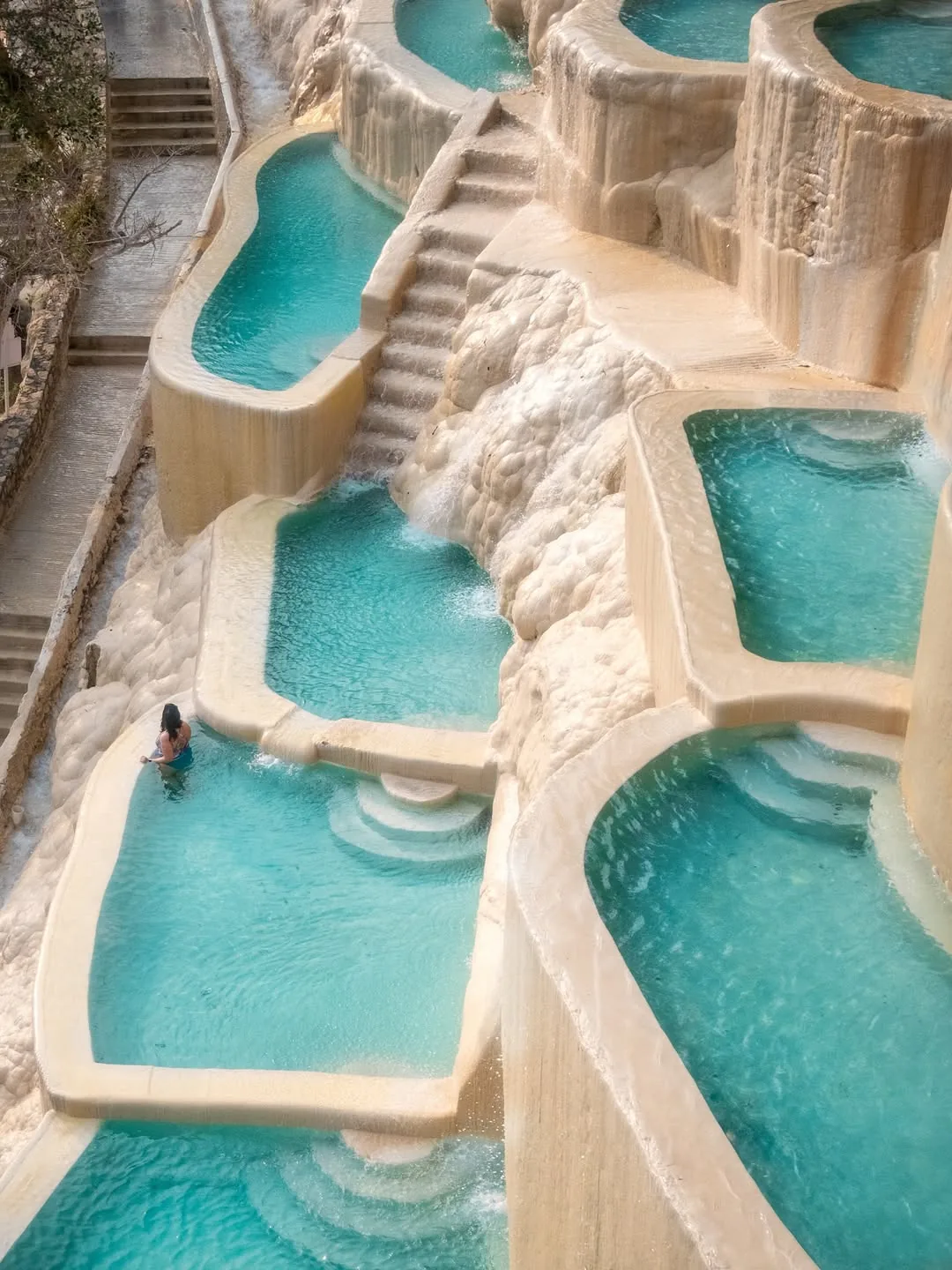
A fascinating aspect is the reverse process: when thermal water loaded with calcium carbonate emerges at the surface and cools, it loses the ability to keep those minerals in solution. The carbonate precipitates and forms travertine deposits — that whitish, porous rock that covers the grotto walls and creates the natural terraces that now serve as terraced pools. This same geological mechanism created the famous terraces of Pamukkale in Turkey and those at Mammoth Hot Springs in Yellowstone.
Tectonic activity in the region also played a determining role. The Sierra Madre Oriental formed from the collision of tectonic plates that lifted marine sediments from the ancient Tethys Sea ocean floor. This is why marine fossils dating from 65 to 100 million years ago can be found in the canyon walls, including mollusk shells and coral remains.
What Are the Dimensions of the Tolantongo Canyon?
The Tolantongo canyon measures approximately 300 meters deep, 3.5 kilometers long, and between 50 and 200 meters wide in its various sections. These dimensions make it one of the deepest canyons in the state of Hidalgo and the Sierra Madre Oriental.
The canyon is oriented in a northeast-southwest direction and was carved by the Tolantongo River over millions of years. The walls are nearly vertical in many sections, formed by limestone strata that can be distinguished as horizontal bands of different shades of gray and cream. In areas where thermal water flows down the walls, travertine forms petrified cascades in white and ochre tones that reach up to 40 meters in height.
The altitude of the canyon floor is approximately 1,400 meters above sea level, while the upper edges reach 1,700 meters. This altitude difference generates a particular microclimate inside the canyon: temperatures are 5°C to 8°C warmer than on the surrounding plateau, and relative humidity exceeds 80% year-round thanks to the constant evaporation of thermal water.
The Tolantongo River flows through the canyon floor with a flow rate that varies between 200 and 500 liters per second depending on the season. During the rainy season (June to September), the flow can double and the water takes on a more intense turquoise tone. In the dry season (November to April), the river is more transparent and calm, ideal for swimming in the natural pools that form between the rocks.
Along the canyon, at least 15 thermal springs have been identified, each with slightly different temperature and chemical composition. The hottest springs are located in the deepest parts of the grottoes, where water emerges directly from fractures in the rock at temperatures up to 40°C (104°F).
What Is the Chemical Composition of the Thermal Water?
The thermal water at Tolantongo is calcium bicarbonate water with a pH of 6.8 to 7.2, containing between 1,200 and 1,800 mg/L of total dissolved solids, and rich in calcium, magnesium, sulfates, and silica. This composition gives it properties that have historically been associated with therapeutic benefits.
The detailed mineral composition of the water, according to hydrogeochemical studies by researchers from UNAM and the Autonomous University of the State of Hidalgo, includes the following main elements:
| Mineral / Parameter | Approximate Concentration |
|---|---|
| Calcium (Ca2+) | 280-350 mg/L |
| Magnesium (Mg2+) | 45-70 mg/L |
| Sodium (Na+) | 15-25 mg/L |
| Bicarbonates (HCO3-) | 800-1,100 mg/L |
| Sulfates (SO42-) | 120-180 mg/L |
| Silica (SiO2) | 35-55 mg/L |
| Iron (Fe) | 0.1-0.5 mg/L |
| pH | 6.8-7.2 |
| Total dissolved solids | 1,200-1,800 mg/L |
The high concentration of calcium bicarbonate is responsible for travertine formation. When the thermal water surfaces and is exposed to air, it loses carbon dioxide through degassing. As it loses that CO2, the solubility of calcium carbonate decreases and it precipitates as a solid, creating the rock formations that characterize the site.
The sulfate and silica content comes from the water’s interaction with deeper layers of volcanic and sedimentary rock. These minerals contribute to the water’s smooth feel and the slight mineral scent perceived inside the grottoes.
The water also contains trace amounts of lithium, strontium, and barium, elements common in deep-origin thermal waters. The presence of these trace elements, along with the elevated temperature, has generated interest in the possible balneological properties of Tolantongo’s water, although it is important to note that specific therapeutic benefits have not been confirmed by rigorous clinical studies.
What Can You See Inside the Grottoes?
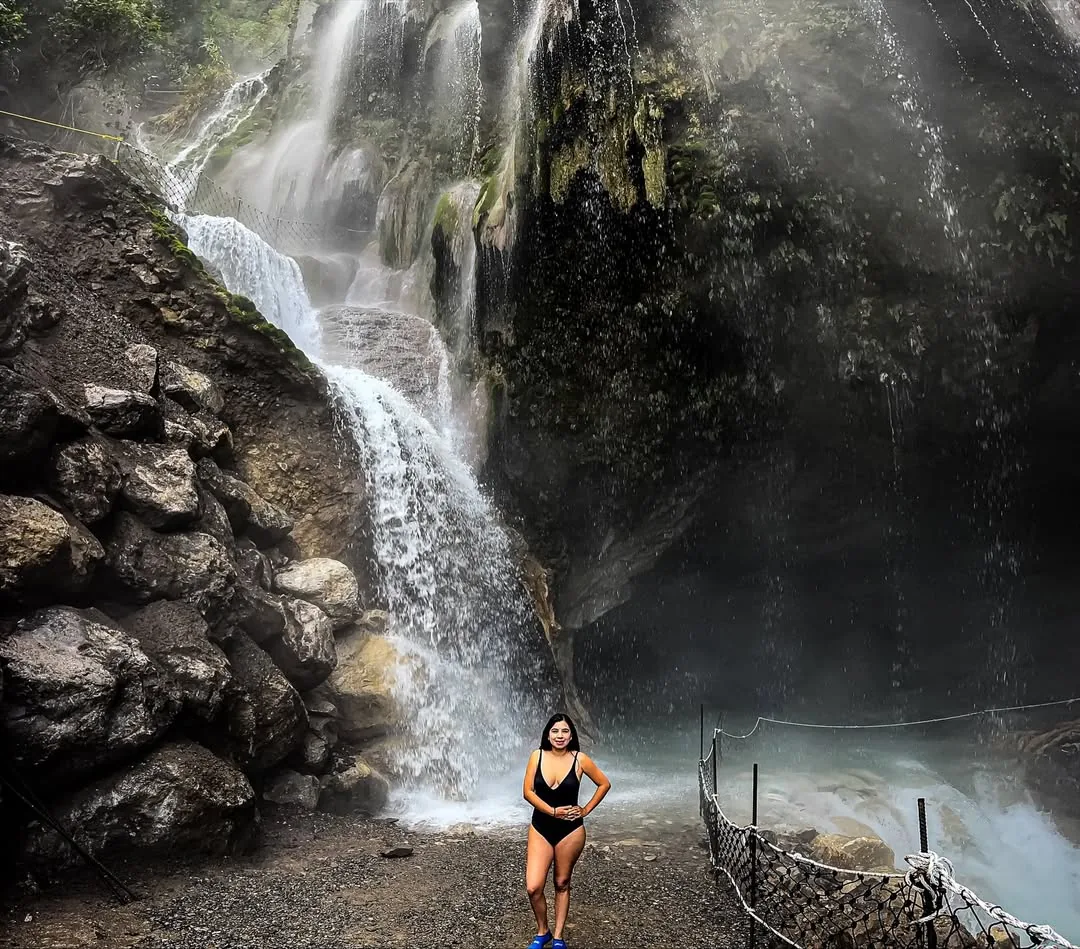
Inside the grottoes you can observe stalactite formations, stalagmites, travertine columns, internal thermal waterfalls, and a main tunnel approximately 40 meters deep with partial lighting. The experience combines geological exploration with bathing in thermal water at 37°C (99°F).
The Gruta Grande (Big Grotto)
The Gruta Grande is the main attraction. Its entrance is located midway up the canyon wall, accessible by a cobblestone path with steps. Upon entering, visitors find a cavern approximately 15 meters wide and 10 meters high. The floor is covered by a layer of thermal water between 30 and 50 centimeters deep that flows constantly toward the exit.
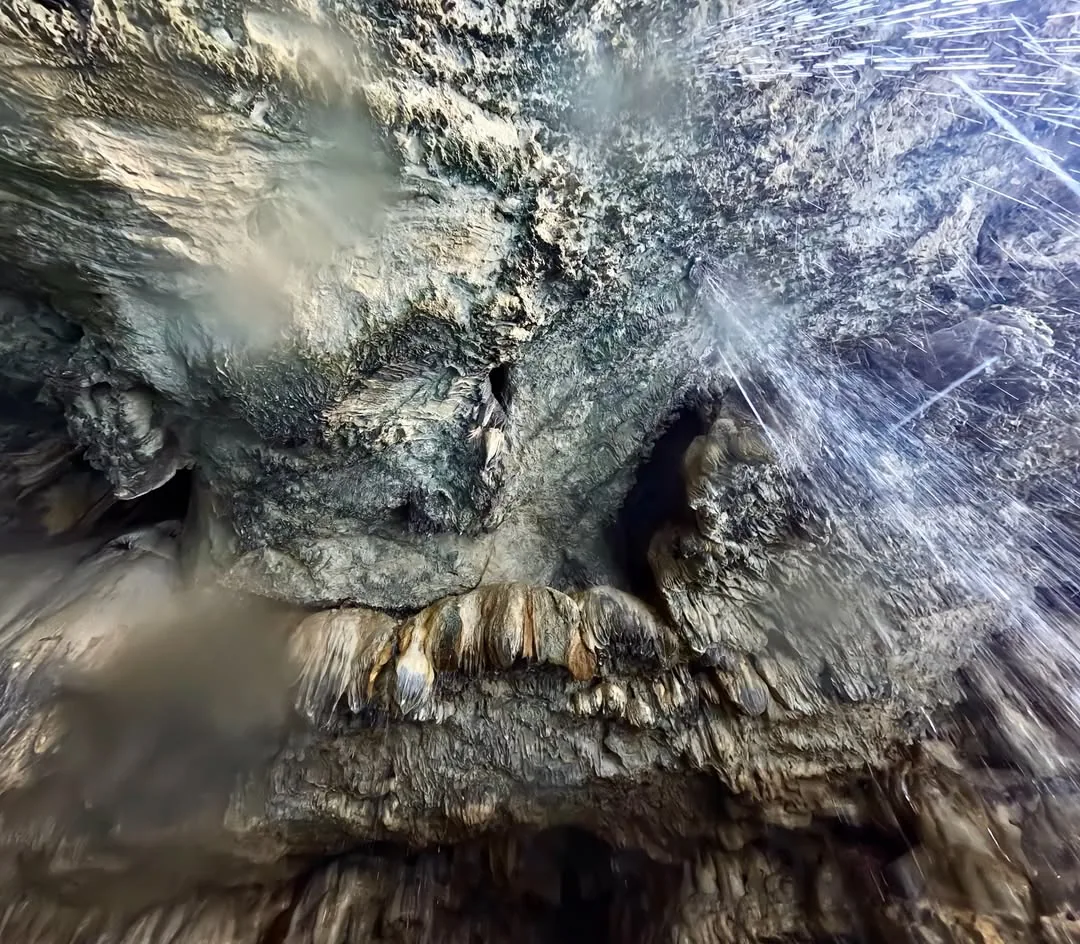
As you advance deeper inside, the tunnel progressively narrows. About 20 meters from the entrance, the ceiling descends to 3-4 meters and the walls close in. The water becomes hotter, reaching 38°C (100°F). Travertine formations cover the walls with textures resembling petrified curtains, with colors ranging from pure white to ochre and green where thermophilic algae grow.
At the deepest point, about 40 meters from the entrance, there is a small thermal waterfall that springs directly from a fracture in the rock. The water falls from a height of 2 meters and produces a resonant sound that fills the entire cavern. It is the hottest and most humid zone, with an ambient temperature that can exceed 40°C (104°F) and humidity near 100%.
The most notable formations include:
- Active stalactites: travertine deposits growing from the ceiling, some up to 60 centimeters long, with drops of mineral water constantly forming at their tips.
- Parietal flowstone: sheets of travertine that coat the walls with undulating shapes, produced by continuous water flow.
- Gours: small natural travertine dams on the floor that form stepped pools 5 to 20 centimeters deep.
- Biofilms: layers of extremophilic microorganisms (bacteria and algae) that survive in hot water and give green and orange tones to certain areas of the rock.
The Gruta Chica (Small Grotto)
Located about 100 meters further along the canyon trail, the Gruta Chica has a narrower entrance (approximately 3 meters wide) but offers a more intimate experience. Its tunnel reaches about 25 meters deep and the water temperature is similar to the Gruta Grande, between 36°C and 38°C (97°F-100°F).
The Gruta Chica stands out for its more delicate speleothem formations: thin straw stalactites (also called soda straws) and small travertine cones on the floor. Being less visited, the formations are better preserved.
Why Is It Called “Tolantongo” and What Does It Mean?
The name Tolantongo comes from the Nahuatl “Tonaltongo,” which translates as “place where it feels warm” or “place of pleasant heat.” This etymology directly reflects the most distinctive characteristic of the site: its warm thermal waters that indigenous peoples knew and used for centuries before the arrival of the Spanish.
The word breaks down into the Nahuatl terms “tonal” (heat, warmth, related to Tonatiuh, the sun god) and “co” (a locative suffix meaning “place of”). Some sources also record the variant “Tollan-tongo,” meaning “small Tula” or “place by the reeds,” in reference to the ancient Toltec city of Tula and the aquatic vegetation growing in nearby marshy areas.
The earliest historical records mentioning the site date from the 16th century, when Augustinian friars documented the existence of “boiling waters in a deep cliff” in the Mezquital Valley region. The Hnahnu (Otomi) people who inhabited the area used the thermal waters for ritual and medicinal purposes, considering them sacred.
For centuries, access to the canyon was extremely difficult. Local inhabitants descended via narrow paths on the cliff walls to reach the river and grottoes. It was not until the 1970s that the first dirt road was built allowing vehicular access, and in the 1990s the current paved road was constructed, zigzagging down the canyon slope.
Today, the Grutas de Tolantongo are managed by a community cooperative made up of ejidatarios (communal land holders) from the town of San Cristobal, municipality of Cardonal. This community-based management has allowed the economic benefits of tourism to be distributed among local families, becoming a nationally recognized model of community ecotourism.
What Swimming Areas Exist at Tolantongo?
Tolantongo has 5 main swimming areas: the two grottoes, the travertine terraced pools (more than 40 pools), the Tunnel of Love, the thermal river, and the camping area with direct water access. Each area has a different temperature and depth, catering to different visitor profiles.
Terraced Pools (Travertine Pools)
The terraced pools are possibly the most iconic image of Tolantongo. They consist of more than 40 natural pools formed by travertine deposits on the canyon slope, arranged in descending terraces. Each pool is between 1 and 3 meters in diameter and between 30 and 80 centimeters deep.
Water arrives from the upper springs and descends by gravity from one pool to the next. The highest pools receive the hottest water (32-35°C / 90-95°F) and as it descends, it gradually cools. The lower pools range between 28°C and 30°C (82-86°F). From these pools you get a panoramic view of the canyon and the river, tens of meters below.
The Tunnel of Love
The Tunnel of Love is a natural rock conduit approximately 10 meters long and 2 meters high, through which thermal water flows at about 34°C (93°F). The water reaches a depth of 50 centimeters to 1 meter. The passage is narrow and dark, creating an accessible underground exploration experience. At the end of the tunnel, a small cavern opens with a thermal waterfall.
The River
The Tolantongo River offers swimming areas with cooler water (20-25°C / 68-77°F) than the springs. Natural pools form between the rocks where the water collects and swimming is possible. The combination of alternating between the hot grotto water and the cool river water is one of the most valued experiences among visitors. For more details on temperatures by area, check our Tolantongo water temperature guide.
What Ecosystem Exists Inside the Canyon?
The Tolantongo canyon harbors a deciduous tropical forest ecosystem with more than 120 identified plant species, including endemic cacti, orchids, tropical ferns, and trees such as the sabino (Montezuma cypress) growing along the river banks. Wildlife includes birds, reptiles, and small mammals adapted to the humid, warm microclimate.
The combination of constant humidity, elevated temperatures, and the protection offered by the canyon walls has created a biological refuge where species from different ecological zones coexist. In the drier upper slope areas, columnar cacti and agaves grow, while at the canyon floor, tree ferns and tropical plants thrive that are not found in the surrounding semi-arid landscape of the Mezquital Valley.
Among the birds recorded in the canyon are the berylline hummingbird, the Mexican trogon, the ladder-backed woodpecker, and various species of warblers and tanagers. Reptiles include endemic lizards and non-venomous snakes. In the river waters, freshwater crabs and small fish adapted to temperature variations live.
The microbial ecosystem of the thermal waters is particularly interesting from a scientific perspective. The thermophilic bacteria and algae communities that form the colorful biofilms inside the grottoes are being studied by biologists from UNAM and other institutions. Some of these microorganisms can survive temperatures exceeding 40°C (104°F) and pH conditions that would be hostile to most living things.
Conservation of this ecosystem depends largely on visitors using biodegradable products. Conventional sunscreen, shampoos, and soaps with synthetic chemicals can alter the water chemistry and affect the thermophilic organisms that are fundamental to the system’s ecological balance. That is why biodegradable sunscreen is mandatory inside Tolantongo, as detailed in our what to bring guide.
What Is Tolantongo’s Geological Significance Internationally?
The Grutas de Tolantongo represent one of the most accessible and best-preserved karst hydrothermal systems in Latin America. Their geological significance lies in the active combination of limestone dissolution, travertine precipitation, and hydrothermal activity at a single publicly accessible site.
Comparable systems worldwide are scarce. The travertine terraces of Pamukkale in Turkey (a UNESCO World Heritage Site) were formed by similar processes but with different water chemistry. The Mammoth Hot Springs in Yellowstone National Park, USA, also share related geological mechanisms. However, Tolantongo is distinguished by being located in a deep river canyon, which adds the dimension of fluvial erosion to the landscape.
Researchers from UNAM’s Institute of Geology have published studies on Tolantongo’s travertine deposition rate, estimating it at approximately 1 to 3 millimeters per year in areas of highest water flow. This means the formations visible today on the canyon walls represent thousands of years of continuous mineral accumulation.
Tolantongo’s hydrothermal system is also relevant for understanding the deep aquifers of the Sierra Madre Oriental. The water that emerges in the grottoes infiltrated as rain in the highlands of the sierra, possibly tens of kilometers away, and took between 50 and 200 years to complete its underground journey before emerging in the canyon. This data, obtained through oxygen and hydrogen isotope analysis, reveals the temporal scale of deep hydrological cycles.
For visitors interested in geology, it is recommended to carefully observe the canyon walls during the drive down. The exposed limestone strata show the geological history of the region: layers of marine sediments deposited when this area was covered by a tropical sea 70-100 million years ago, now lifted more than 1,500 meters above sea level by the force of plate tectonics.
How to Plan a Visit to Make the Most of the Geological Experience?
To make the most of Tolantongo’s geological experience, it is recommended to arrive early (before 9:00 a.m.), visit the grottoes first when crowds are lightest, carry a flashlight to observe formations, and dedicate at least a full day to touring all 5 swimming areas at a relaxed pace.
Recommended Itinerary
| Time | Activity | Area |
|---|---|---|
| 8:00-9:00 | Arrival and check-in | Main entrance |
| 9:00-10:30 | Grotto exploration | Gruta Grande and Gruta Chica |
| 10:30-12:00 | Terraced pools | Travertine terraces |
| 12:00-1:00 | Tunnel of Love | Thermal conduit |
| 1:00-2:30 | Lunch | Park restaurants |
| 2:30-4:00 | River and natural pools | Canyon floor |
| 4:00-5:00 | Second visit to pools | Upper terraces |
Geological Visit Checklist
- Arrive before 9:00 a.m. to avoid crowds at the grottoes
- Bring a powerful flashlight to observe stalactites and formations
- Wear non-slip water shoes (wet rocks are slippery)
- Bring enough cash (check the updated prices)
- Observe the strata in the canyon walls during the descent
- Look for marine fossils in exposed rocks (observe only, do not extract)
- Note the temperature differences between areas
- Photograph travertine formations with a scale reference
- Use only biodegradable sunscreen to protect the ecosystem
- Check the how to get there guide before departing
Frequently asked questions
What type of rock makes up the Grutas de Tolantongo?
The Grutas de Tolantongo are formed primarily of limestone (calcium carbonate) and travertine, deposited over thousands of years by mineral-rich thermal water that dissolves the bedrock and redeposits it as it cools at the surface.
Is it dangerous to enter the Grutas de Tolantongo?
It is not dangerous if you take basic precautions: wear non-slip water shoes, carry a flashlight, stay within marked areas, and follow staff instructions. The public areas are supervised and have partial lighting.
Why is the water at Tolantongo hot?
The water is hot because it filters down more than 1,500 meters deep where geothermal heat from underground warms it to between 36°C and 38°C (97°F-100°F). As it rises through fractures in the limestone, it maintains that temperature until it emerges at the canyon surface.
How many grottoes are there at Tolantongo?
There are two main grottoes open to the public: the Gruta Grande (Big Grotto), which is the most visited with a tunnel approximately 40 meters deep, and the Gruta Chica (Small Grotto), narrower but equally impressive. Both have thermal water between 36°C and 38°C.
How long does it take to tour the grottoes?
A complete tour of both grottoes takes between 45 minutes and 1 hour 30 minutes, depending on your pace and stops to enjoy the thermal water. Most visitors spend 2 to 3 hours including rest breaks.